Got a question?

Administration
It is no longer just about producing more renewable energy. The green transition is increasingly about how energy and CO₂ are moved, handled and stored – and about how the infrastructure we build can give something back to nature.
In the future, we will continue to have emissions from heavy industry in Europe that cannot be eliminated through electrification, and for many years to come, our energy supply will consist of both renewable energy and fossil fuels. The transition must therefore be addressed across the entire value chain – not just at the production stage.
In this edition of Port Esbjerg's newsletter, we look at four aspects of this development: CO₂ storage in the North Sea, regenerative construction, integrating energy into the grid and Europe's energy security.
A new industry in operation
With Project Greensand, the entire chain from capture and transport to storage of CO₂ has been put into commercial operation for the first time in the EU. This means that technology is no longer the big question for carbon capture and storage (CCS) initiatives. Scale is.
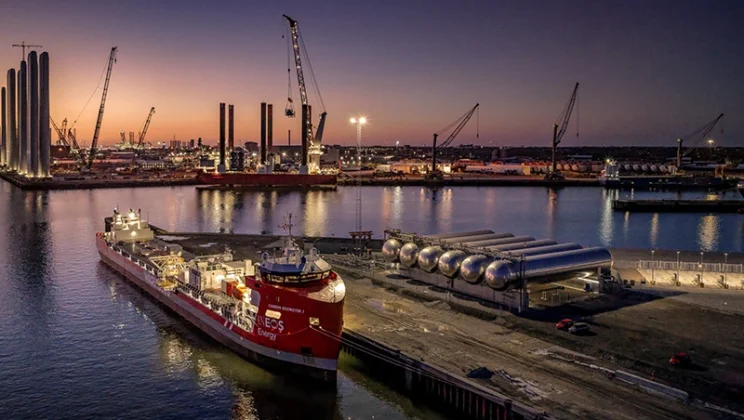
Photo: Robert Attermann, RED STAR 2.0
If CCS is to make a real difference, far more companies and far larger volumes must be handled – not least from German industry, which has limited options for storing CO₂ itself. This represents enormous potential for a new Danish North Sea success story, with Port Esbjerg playing a key role. The storage sites in the North Sea are very large, and Danish geology is ideal for storing CO₂.
When infrastructure is also nature
Biodiversity cannot be quantified as simply as CO₂. That is one of the reasons why nature is rarely included as a measurable part of maritime construction projects.
This is now changing. At Port Esbjerg, we are testing solutions in which biodiversity is integrated into the structures themselves. Examples include units on quay walls that, across projects, have increased the number of species by 100–150 per cent on average, and concrete blocks in which clay from Port Esbjerg's dredging forms part of the concrete mix.
These are complemented by 3D-printed reefs designed to be built into the waterfront from the outset. When the results are measured and documented, nature becomes something that can more easily be factored into decision-making on an equal footing with other requirements.
Danish expertise lies in the system
When a World Bank-led delegation with participants from Vietnam, Brazil and other emerging markets visited Denmark, it was not primarily the wind turbines they came to see. It was the system – and Port Esbjerg was the first stop on the tour.
The delegation studied how to balance supply and demand when generation varies. What do you do with surplus power – and what is the plan when the wind isn't blowing?
In many countries, grid expansion is lagging behind the expansion of renewable energy. Here, the Danish experience shows that gigawatt-scale offshore wind requires grids, interconnectors to neighbouring countries and market models to be developed in parallel.
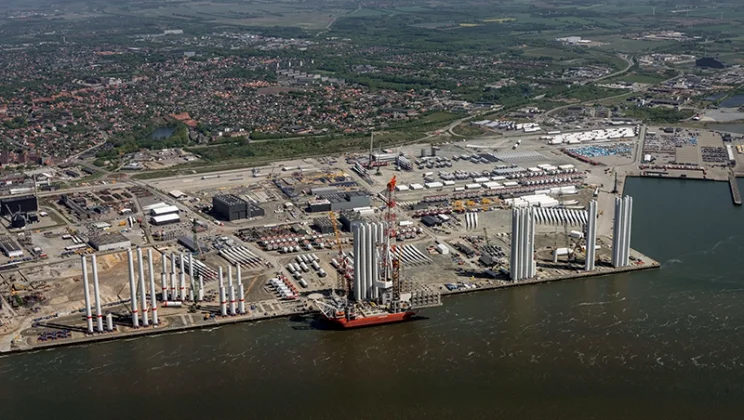
Photo: Robert Attermann, RED STAR 2.0
The right framework sets the pace
Patrick Verhoeven of the international port organisation IAPH is clear: Europe will need a bigger network to bring energy in, and that network must be built now. In this context, a number of smaller ports could take on a significantly greater role.
Fossil fuels and LNG will remain part of the energy supply for longer than expected, which is precisely why it will be crucial to have the infrastructure for both green energy and imports in place. Nine countries have also joined the Clean Energy Marine Hubs initiative.
The common thread running through the four stories is that the technology is largely available. What determines the pace is volume, business models, grids, regulation and planning. This is also where the next major decisions must be made. The locations where the framework is ready when the investments come will be best placed.
They are the ones that will set the direction.
Go to overview