Got a question?

Administration
There is a clear goal of increasing biodiversity at Port Esbjerg. And a number of bio-projects are now linked to the port expansions being carried out to serve the green transition in the North Sea. Here you can read about three pioneering projects.
Decarbonisation has been one of the major topics for ports for a number of years, but there is now a growing global trend focused on improving water quality.
Is it possible to build regeneratively – that is, to increase biodiversity and absorb CO₂ – while carrying out extensive improvements at Port Esbjerg? It is a question being worked on intensively in Esbjerg, and alliances have been formed with some of the most innovative players in the field.
One of them is David Rodés, Chief Development Officer at Ocean Ecostructures – a company working to unlock so-called regeneration capacity.
"We increase biodiversity and measure the results to create tangible benefits. Our goal is to turn ports into engines of ocean regeneration," says David Rodés. He elaborates:
"Ports have an enormous capacity to contribute to regeneration. To achieve this, we work with the entire port community – companies, authorities and other stakeholders. We focus on technology to develop the most effective and impactful solutions. We also monitor the results closely."
Life Boosting Units in Esbjerg
At Port Esbjerg, Ocean Ecostructures has installed so-called LBUs – Life Boosting Units. Each Life Boosting Unit is 1 metre wide, 1.5 metres high and 35 centimetres deep. They are installed on vertical quay walls and piles.
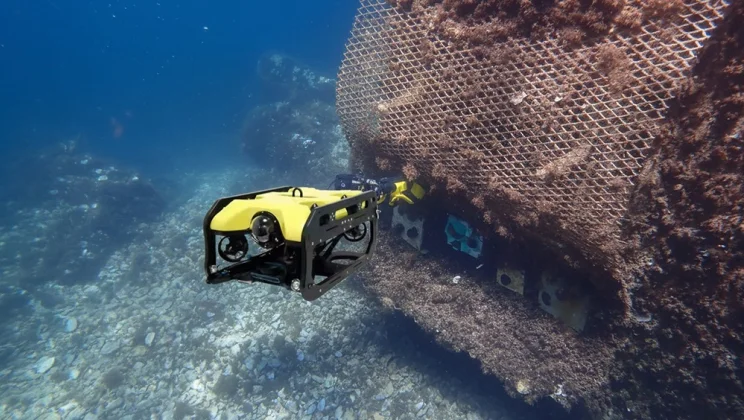
Photo: Ocean Ecostructures
"We installed the units at Port Esbjerg in February, and we carried out the first monitoring a few weeks ago. We are now processing the results and solutions," says David Rodés, adding:
"In the Esbjerg project, we expect to increase the diversity and complexity of the ecosystem. There was already marine life in the area, including oysters, but we expect the ecosystem to become more complex and that we will see more species."
"On average across our projects, we see the number of species increase by 100–150 per cent, while the biomass on the wall increases by around 200 per cent. Once we have documented that the solution works, we involve the wider port community. We work with them – because they too can contribute to regenerating the marine environment."
Combining three elements
LBUs combine three things. The first element is a system for attracting microfauna, called Life Boosting Mix. It is a natural solution designed so that the microorganisms in the water are attracted to the LBU.
The second is a calcium carbonate substrate – ideal for colonisation by the microorganisms that reach the structure. The third is a special multi-layered design.
"We provide space to breathe and for nutrients, and together these three elements mimic the way a natural reef works. This creates the right habitat for the development of complex, more resilient ecosystems."
David Rodés also stresses that monitoring is crucial.
"We measure precisely and consistently over time, which enables us to understand the additional effect compared with the surrounding environment."
A new green building material
ECOncrete is behind another spectacular project. The company is producing eco-designed blocks for Port Esbjerg, using clay from its own dredging in the concrete mix.
The blocks will be used for coastal protection and to restore biodiversity at Port Esbjerg. Around 40 per cent of production is complete, and those blocks will be installed at Port Esbjerg this year. The remaining 60 per cent will be produced and installed after the winter.
The aim is to enable a marine ecosystem to develop and thrive as an integral part of the necessary infrastructure, from breakwaters to the protection of subsea cables. Artificial reefs are created and integrated as elements of the infrastructure.
In addition, sediment and sand from dredging – of navigation channels, among other things – are being used as material for building concrete structures, for example for coastal protection and quays.
"Port Esbjerg's challenge is to find a useful application for dredged material such as sediment. It has large quantities of dredged material lying in stockpiles," says Jaime Orduña Mozo, Chief Operating Officer (COO) at ECOncrete. He describes the process:
"Port Esbjerg asked us: can you work with this? We replied that we are experts in concrete and in adapting and validating new technologies for use in maritime infrastructure. And that we would like to try to find a solution," says Jaime Orduña Mozo, explaining that the company is working to make these kinds of new materials – from sediment and clay – ready for the construction industry at scale.
"There are many advantages to using dredged material in construction and replacing cement. The potential is enormous, but we also need to be realistic and work project by project. There is still a lot to be done, including development and testing," he says, reporting growing interest in Europe and the US.
ECOncrete currently has 15 projects under way and has completed more than 100 projects worldwide. Data from these projects is used to further develop and optimise designs and solutions.
"We are excited to continue and strengthen our joint work with Port Esbjerg on making use of the dredged material. It is a new and innovative approach to the beneficial use of port dredgings, opening up new opportunities to create value in maritime construction projects," says Jaime Orduña Mozo.
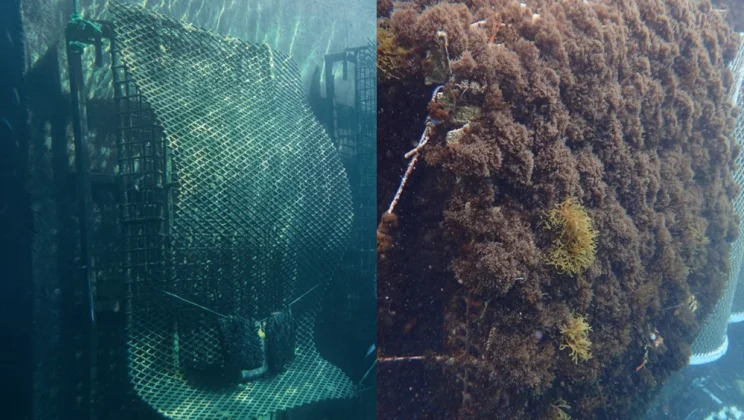
Photo: Ocean Ecostructures
Danish reef modules on the rise
A third company working with biodiversity at Port Esbjerg is the Danish firm Stonereefs. The company has installed more than 1,200 reef modules in Denmark and Ireland.
In 2021, Mikkel Brich founded 3DCP Group – together with Hasan Alsofi – a company working with 3D-printed construction. In 2024, they went on to found Stonereefs, which develops and 3D-prints artificial reefs for ports and maritime infrastructure.
"There is a somewhat unspoken assumption that heavy industry and maritime infrastructure are at odds with healthy biodiversity – but that doesn't have to be the case if you think things through. One of the challenges, however, is that biodiversity cannot be quantified in the same simple way as CO₂," says Mikkel Brich. He elaborates:
"That's why we agreed with Port Esbjerg to launch a development project based on the renovation of a sheet pile wall: can we develop a solution in which biodiversity is not added afterwards but is integrated into the structural waterfront from the outset?"
In connection with the project, a Eurostars application has been submitted together with SDU (University of Southern Denmark), University College Dublin and HTL – with Port Esbjerg as case study and partner.
"The aim is to secure funding for the development, but the project does not depend on us receiving the grant. If Eurostars doesn't work out, we will look at Innovation Fund Denmark, among others. In parallel, we are moving ahead with installing and testing a solution on an existing sheet pile wall," says Mikkel Brich.
Go to overview