Got a question?

Administration
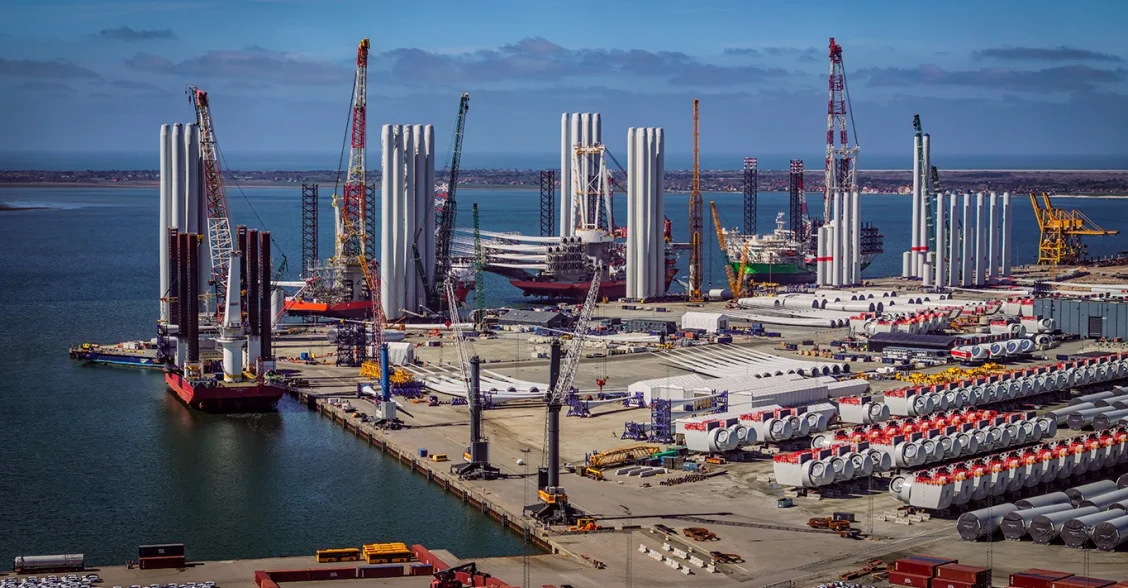
The World Economic Forum has selected Port Esbjerg as part of its global Transitioning Industrial Clusters initiative. This places Port Esbjerg among a select group of just 40 clusters worldwide – across 20 countries. Esbjerg is the only one in Denmark.
According to the World Economic Forum’s project description, the Port Esbjerg cluster aims to become a low-emission, multi-energy hub for Europe.
“Being a Transitioning Industrial Cluster means that Port Esbjerg plays an important role in the green transition and is an integrated part of Europe’s green transformation,” says CEO Dennis Jul Pedersen. He adds:
“We can see that clusters across Europe and globally can make a real difference. When major players take part in the development, as they do at Port Esbjerg, it can also drive economic growth – while accelerating the green transition.”
Esbjerg’s green strengths go beyond offshore wind
The World Economic Forum highlights that the Port Esbjerg cluster aims to bring together wind power, CO₂ transport and storage, hydrogen production, and industrial innovation to deliver secure, low-emission energy at scale.
A Transitioning Industrial Cluster (TIC), as defined by the World Economic Forum, is a network of 40 active industrial clusters globally working to accelerate the transition through collaboration between businesses and public stakeholders.
This makes the Port of Esbjerg a Danish reference point for driving the transition forward through cooperation.
In Esbjerg, strategies are already in place for carbon management and hydrogen. Hydrogen production can be used in heavy industry – and to supply green power to large data centres. The Draghi report on EU competitiveness highlighted the importance of being part of the tech ecosystem, and there are now major plans for data centres in Esbjerg.
“When it comes to large-scale green transformation, it is industrial clusters that drive change. For example, some of Europe’s largest ports consume as much electricity as three quarters of Denmark’s total demand. That means change must also come from large ports. Port Esbjerg is one of them – and we are much more than offshore wind,” says Dennis Jul Pedersen.
Mayor highlights collaboration
Esbjerg’s mayor, Jesper Frost Rasmussen, sees the TIC designation as recognition of the many significant activities taking place around the port – particularly within the green transition.
“It becomes very clear when you are the only Danish actor to receive this recognition,” he says.
“I am proud of that as mayor. It reflects strong work by the companies at the port. It is all built on close collaboration – the Port of Esbjerg drives many initiatives itself, but also plays an important role in supporting private companies. The port, the municipality, and citizens work closely together – things happen collectively.”
The mayor also highlights Esbjerg’s strong focus on CO₂ storage, where the city plays a role in establishing a missing link in the value chain.
“What the port has done particularly well is to be forward-looking and to identify potential and opportunities. Energy has been a key focus area for the Port of Esbjerg for many years. This includes offshore wind logistics as well as the production of green fuels such as hydrogen and ammonia. Work is also underway on shore power based on fuel cells,” says Jesper Frost Rasmussen.
Facts: Transitioning industrial clusters (TIC)
The World Economic Forum describes TIC as a network of 40 active industrial clusters globally working to accelerate the transition through collaboration between businesses and public actors.
A Transitioning Industrial Cluster is a geographic area where companies and public institutions work together to shift an industrial region from fossil dependency to low-emission operations.
The idea is that clusters can share infrastructure, resources, and risk – thereby accelerating investments and reductions at a scale that is difficult to achieve through individual projects.
The World Economic Forum also highlights that industrial clusters can drive transformative action – precisely because they can establish shared governance and coordinate policy, financing, partnerships, and technology deployment.
- World Economic Forum on TIC: described as 40 active industrial clusters globally
- Denmark: Esbjerg Industrial Cluster is the only TIC profile listed with the location ‘Denmark’ in publicly available project profiles
- Greensand/Esbjerg: CO₂ terminal with six storage tanks of approx. 1,000 tonnes each – described as the ‘first gateway for carbon storage in the EU’
- Bifrost: EU-designated PCI project – expected operational around 2030 – up to 335 Mt CO₂ over its lifetime
Read more on the World Economic Forum website:
https://initiatives.weforum.org/transitioning-industrial-clusters/community
https://initiatives.weforum.org/transitioning-industrial-clusters/project-details/esbjerg-industrial-cluster/a0sTG000002jkC1YAI
Go to overview