Got a question?

Administration
Drones can deliver spare parts to offshore wind turbines, jack-up rigs, and vessels. Self-driving trucks are already running commercial routes on American roads, and the technology is advancing fast in Europe too. DSV's assessment is unambiguous: the technology is mature, and Denmark's neighbours are already well ahead — with valuable lessons for Denmark to draw on.
For Denmark to hold its position as one of Europe's leading hubs for offshore, offshore wind, and advanced logistics, fresh thinking is needed.
That is especially true for autonomous transport, where drones and self-driving trucks are both expected to reshape how goods move.
But this is not just a technology question. It matters just as much that companies get the chance to test these solutions in the field. The EU is working on legislation in this area, but until common rules are in place, individual countries are setting the pace.
Denmark can learn from its neighbours
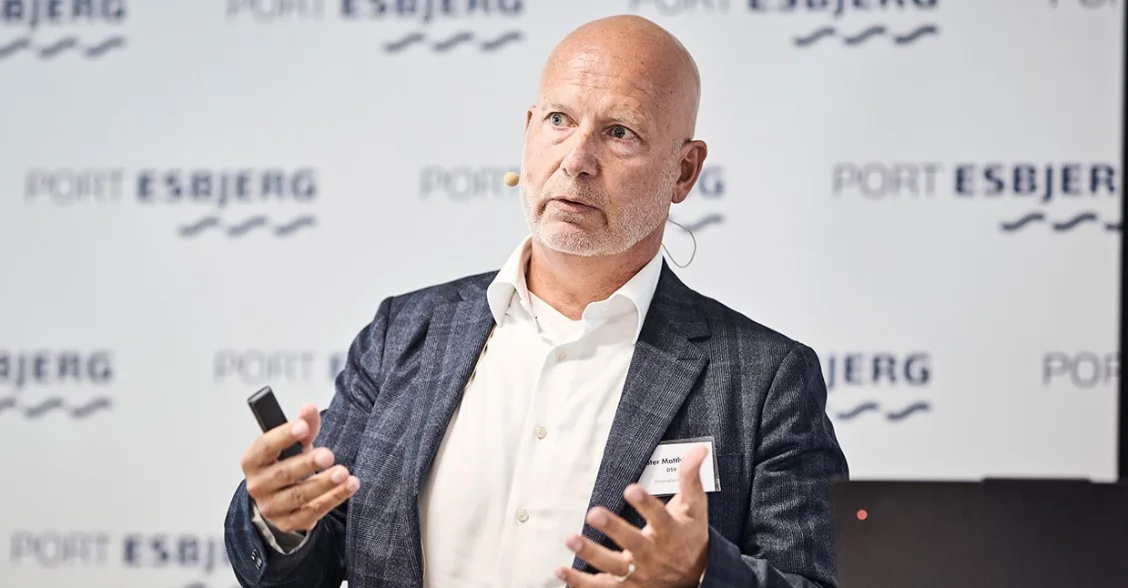
For companies like DSV, the question is no longer whether the technology works — it does. The real question is how quickly legislation and regulators can keep pace, according to Peter Matthiesen, Head of Group Innovation at DSV.
"Germany and the Netherlands are far ahead, and Norway is also making strong progress. Some countries have generally chosen to embrace autonomy and incorporated it into legislation at an early stage. This requires governments that are supportive and willing to be first movers," says Peter Matthiesen, adding:
"The Germans aren't always first movers, but specifically on autonomy, they are well ahead. We've applied for permits there and received them with strong support from the entire ecosystem. In Denmark, we haven't had the same experience. Last year was likely also shaped by some unfortunate incidents (referring to the drone sightings over, among other places, Copenhagen Airport). Progress has since been made through the 'regulatory sandbox scheme,' but we're still somewhat impatient."
The regulatory sandbox is a step in the right direction
The regulatory sandbox scheme refers to a project at the Port of Esbjerg, part of the Danish government's regulatory sandbox initiative, launched under the 2024 Entrepreneurship Agreement.
The project focuses on the use of drones in port environments for purposes including logistics, inspection, and security. DSV, the Port of Esbjerg, and Vestas are developing drone logistics under real-world conditions.
The program lets companies and public authorities trial new solutions under real-world conditions. This can speed up the market introduction of innovative technologies and generate practical insights that feed into future Danish regulation — including a clearer path to drone-based offshore logistics.
"If you're looking for the low-hanging fruit, you should look at what other countries have done. The Germans have clearly found a framework that works and have gotten their drones flying. We need a framework that allows us to do the same," says Peter Matthiesen.
What's holding back the legislation?
"Perhaps the Danish Transport Authority lacks the necessary expertise, given that this is new technology. There may also be a degree of reluctance following last year's unfortunate drone incidents. Massive investment is being made in drone technology as a result of the war in Ukraine, so the technology is readily available. But people still become quite anxious when they hear a drone."
Peter Matthiesen points out that companies lack even basic guidelines from the authorities.
"Right now, we can't even submit an application to use drones, because there is no clear model for what an application should look like or what it should contain," he says.
Offshore deliveries in Esbjerg
For DSV, drones are not about delivering small parcels to private customers. The real potential lies in critical deliveries, where even minor downtime — for example, at offshore installations — can have significant financial consequences.
"We want to deliver spare parts offshore from Esbjerg — to oil, gas, wind, and shipping — and to any other location where downtime is costly and where the use of drones can be justified. Data centres are also a natural customer segment, since downtime there is similarly expensive. Critical infrastructure is another relevant area," says Peter Matthiesen.
The opportunities extend well beyond transport, which is naturally DSV's primary focus.
Within port operations, autonomous drones can monitor large areas, detect smoke, identify fires, or automatically flag irregularities using advanced camera technology.
At the Port of Esbjerg, drones can be used for port surveillance, fire detection, smoke monitoring, and camera-based vision systems that automatically identify anomalies.
On the maritime side, there are further opportunities, notes Peter Matthiesen.
"Some shipping companies are working on processes to track vessel arrivals and monitor their proximity to the quay. There's also interest in ship inspection, so shipping companies are exploring various applications for drones."
The drone is just one part of the logistics chain
According to Peter Matthiesen, it is a common misconception that drone deliveries are only about the flight itself. The real value emerges when the drone becomes a fully integrated part of the supply chain.
"For us, logistics is fundamentally about getting goods all the way to their final destination. Today, we deliver to the port, after which the party responsible for the final leg handles onward transport. Drone deliveries would be a natural extension of our transport chain," he says, adding:
"Many startups want to offer drone deliveries, but they don't have the rest of the logistics chain. We manage the entire process from producer to customer. If the goods aren't ready to be flown out, the drone doesn't help. That's why we also operate the warehouse that manages the spare parts to be transported by drone."
It is precisely this end-to-end logistics capability that makes the technology compelling for a company like DSV.
Self-driving trucks are getting closer
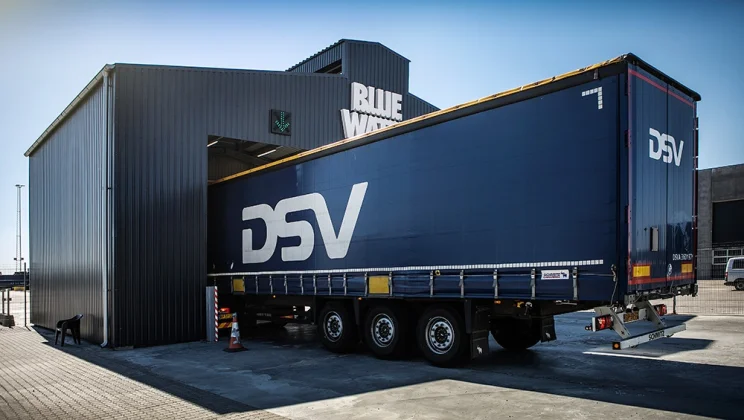
Developments are not limited to the skies. DSV is also closely following advances in autonomous trucking, where several manufacturers are approaching commercial operation.
"Autonomy spans road, air, and sea — self-driving forklifts, drones that fly themselves, and other autonomous systems. On the drone side, operators were previously only permitted to fly within visual line of sight. Now, drones can fly far beyond that range."
The Netherlands is among the countries leading the way. Rotterdam has been a frontrunner, and the necessary legislation is in place there. At the same time, public trust in the technology remains essential.
"When people see self-driving vehicles operating safely on the roads, they become more confident, which can pave the way for autonomous heavy transport," notes Peter Matthiesen, adding:
"We're not quite there yet with self-driving trucks, but the Dutch have been working on the transport corridor between Rotterdam and Antwerp, examining how it could be automated. They've launched a number of domestic projects and have fully committed to this development."
The driver's role is evolving
Until now, the driver has served as the redundant system required as a backup for the technology.
Once the driver is eventually removed, a reliable — and approved — technical backup system will need to be in place. According to Peter Matthiesen, however, this does not mean truck drivers will become entirely redundant.
"We're talking about trucks operating between terminals on highways. Volvo has stated that it expects to be able to remove technicians (drivers, ed.) from its trucks by 2027. For that to happen, the vehicles need to be fully redundant, with a complete backup system," says Peter Matthiesen.
"Long-haul drivers will increasingly become distribution drivers, while new roles will emerge, such as controllers and terminal staff. Many of the tasks currently performed from the driver's cab will be carried out from an office or a terminal instead."
There will naturally be labour cost savings to be gained, but the greater benefit lies largely in improved utilization of the trucks themselves. Today, many trucks sit idle while drivers rest, and an export truck covers roughly 120,000 kilometres a year on average.
"The goal is to increase that to around 250,000 kilometres a year, which could also reduce the number of trucks required."
Momentum continues to build. For DSV, the years ahead are therefore not about proving that the technology works, but about ensuring that Denmark — among others — establishes the framework needed to translate this potential into practical solutions.
Go to overview