Got a question?

Administration
Esbjerg has been chosen as the preferred location for a new pilot facility that will convert dry ice into liquid CO₂. Shipping containers could thus become the key to making CO₂ transport accessible to far more companies.
The Port of Esbjerg has been earmarked as a centre for CO₂ storage, one of the technologies that will be crucial if we are to meet our climate targets in the future. The potential is enormous — but so are the technical challenges.
Today, CO₂ is transported under high pressure — typically in pipelines or in tanker trucks or ships with pressure tanks. This is not only a major expense; it is practically impossible to scale to every corner of the globe.
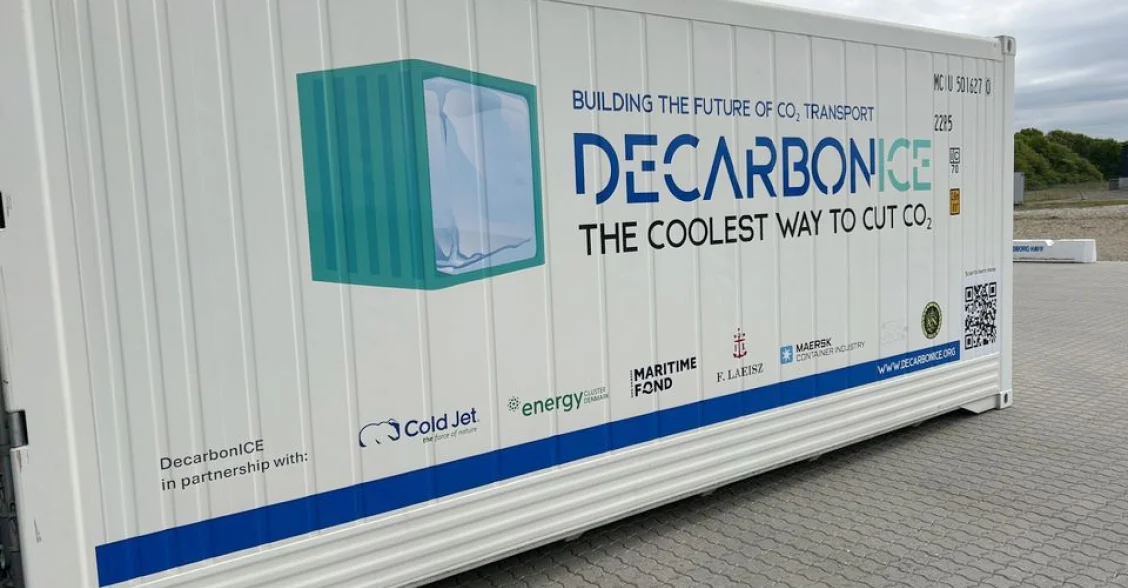
A new Danish start-up wants to use shipping containers to transport CO₂ in the form of dry ice, thereby leveraging an infrastructure that has already been rolled out to virtually the entire world: the shipping container. This would make it possible to reach small and medium-sized enterprises spread across large geographical areas.
The container in question is a standard 20-foot shipping container, insulated so that CO₂ can be transported as dry ice at atmospheric pressure. Behind the innovation project stand both companies and research institutions, including Aarhus University, Maersk Container Industry, the Port of Esbjerg, and Energy Cluster Denmark. The expectation is to have a commercial solution ready as early as 2028.
The company behind it is DecarbonICE, which has developed the super-insulated, patented container. Henrik O. Madsen, CEO of DecarbonICE, says that a single container will be able to hold up to 21 tonnes of dry ice — that is, frozen CO₂. The containers keep the dry ice at atmospheric pressure and can be transported using standard logistics solutions such as lorries, trains, ships, and barges. The dry ice is delivered in pellet form, making it possible to handle in large quantities. With 43 million shipping containers in circulation worldwide, just a small percentage would be enough to transport a large share of the CO₂ expected to be captured in the future.
"Our advantage is that the infrastructure and the containers already exist. Today, transporting CO₂ is expensive and cumbersome. There are certainly large companies and emitters willing to invest in a dedicated transport solution, but for many small and medium-sized enterprises spread across large geographical areas, that simply won't be realistic. Those are the companies we can help," says Henrik O. Madsen, who in recent weeks alone has been contacted by companies in the United States and Switzerland, even though the technology was only launched this year.
He estimates that the solution will significantly reduce capital costs for transport and cut operating costs by up to 30 per cent.
"Just to give an example: we have been in contact with a biogas plant that had purchased eight tanker trucks to transport liquid CO₂. Each truck costs around two million kroner (€268,000). By comparison, I expect our container to cost around 50,000 kroner (€6,700),” says Henrik O. Madsen, adding that the company is working with Maersk Container Industry to produce thermally insulated containers in China, where Maersk Container Industry already has an existing container production facility.
A supplement
Henrik O. Madsen stresses that the technology should be seen as a supplement to the other investments currently being made in CO₂ infrastructure. It is typically some of Denmark's largest emitters — power plants, cement factories, and other heavy industries — that invest in dedicated infrastructure such as pipelines and pressure tanks. That will continue to be necessary.
"We have no ambitions to compete with the pipelines. They will remain relevant for large industries with very different needs. But small and medium-sized enterprises will also have to address climate requirements — and they too have processes where producing CO₂ will be unavoidable in the future," says Henrik O. Madsen.
"You can also easily imagine transporting CO₂ in the containers to pipeline connections, for example. The two forms of infrastructure could work very well together," he says.
Esbjerg was the first choice
As part of the project, a facility will be established at the Port of Esbjerg to convert dry ice back into liquid CO₂. The unit requires only limited energy input, as it draws heat from the surrounding environment. When the facility is ready in 2028 or 2029, it will be connected to Project Greensand, which stores CO₂ in a former oil and gas field in the North Sea.
"We have spoken with many ports about where this could work, but Esbjerg is the leading port in CCS — Carbon Capture and Storage — so it was a natural place to locate the facility. It is about proximity to the North Sea and Project Greensand," says Henrik O. Madsen.
According to the partners behind the project, the market for CO₂ storage will be enormous in the coming decades. By 2050 alone, the global market is expected to reach six billion tonnes — a scale that will be essential if there is to be a realistic path to limiting global warming.
And it is precisely important to look beyond national borders, says Henrik O. Madsen.
"If this is to be commercially viable in the long run, we will be importing CO₂ from other countries facing the same challenges in meeting their climate targets as we are. And the Port of Esbjerg is strategically well positioned for that," says Madsen, adding that the Port of Esbjerg was also quick to grasp the idea and understand its potential.
"They understood it immediately. We were almost stopped mid-presentation — it was a very dynamic process," he concludes.
Go to overview