Got a question?

Administration
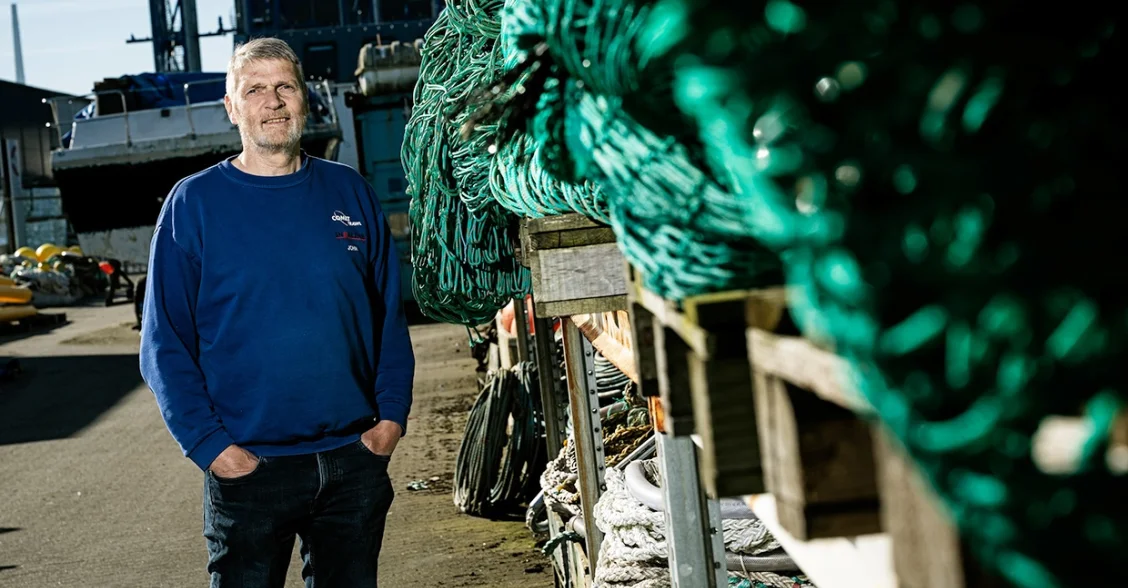
John Brink started his apprenticeship at one of Esbjerg’s 13 net-making workshops in 1979 at the age of 16. Today, he owns Comet Trawl – the last remaining net-making business at Port Esbjerg. But the traditional trade is now branching out in new directions.
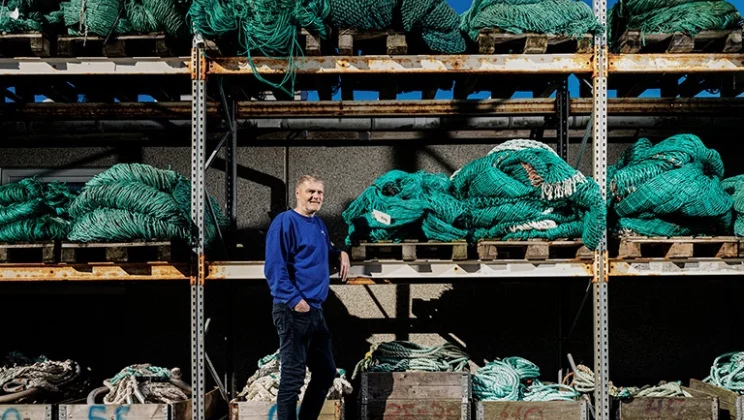
Comet Trawl is located in a large warehouse close to the waterfront, with ropes of all kinds spread across the 900 square metres alongside buoys and fishing trawls.
John Brink looks out over the ropes.
“I have been away from it at times, but since 1997 I have worked full-time as a net maker,” he says.
To the untrained eye, the warehouse may seem cluttered, but a closer look reveals that everything is carefully organised and tailored to customers’ needs, while five employees are busy with ongoing tasks.
A broad craft
Comet Trawl once focused solely on fishing nets. Today, the business is far more diverse. It now covers offshore and commercial fishing, ropes and wire, sports equipment, wire mesh and railings, screening and safety solutions, biogas nets and agriculture – as well as vortex solutions for wind turbines.
“We have a solid business,” says John Brink.
“We have a number of large customers in offshore and construction, but we also make nets for Mrs Hansen’s attic, when she wants it secured for her grandchildren. Small customers also help build the business,” he adds.
A large ecosystem
Comet Trawl was founded when fisherman Simon Rejkjær was injured in the early 1960s and had to come ashore. At that time, hundreds of trawlers created a whole ecosystem.
“There were three to four crew members on each vessel, and they supported blacksmiths, net makers, suppliers, oil traders and more – a much broader ecosystem than with the large vessels today,” says John Brink.
Today, the port has around 10 shrimp trawlers and about 20 fishing vessels in total – compared to nearly 700 in the past.
“So, you have to find new niches to work in,” says John Brink, who bought into Comet Trawl in 1999 and later became sole owner.
How many years did you only produce fishing nets?
“We have never really only made fishing nets – we were one of the smaller workshops, so we could not afford to turn down other work. Some of those tasks have grown over time. But fishing was a major part of the business until about 10–12 years ago. Buoys were added around 15 years ago. We have also had major offshore projects for Siemens, which was by far our largest customer for several years. We produced vortex ropes that were mounted on turbine towers while they were on the quay.”
Why did you choose to become a net maker?
“My father was a fisherman, and my grandfather was a fisherman, but I did not have time to go fishing because I played handball at a high level in Esbjerg. I could not be at sea for long periods.
But it also is a great job. We all enjoy our work. We find it interesting. Since I was young, I have also liked the atmosphere at the port. It was not very strict. The environment was relaxed, and you always started with a cup of coffee.”
What does the craft require?
“You need to learn how to tie knots correctly, and how to splice rope or wire. You do not need much – just a netting needle, a knife, and a marlinespike. That’s it. However, we also have a machine for pressing eyes onto steel wires.
In fishing, it is a bit like being a tailor – there are many different mesh sizes and thicknesses. We cut and assemble it. Like a thatcher, they do not use many tools either. It is very basic, just your hands and a few tools. It is not really an education you can take locally anymore, but it takes about three years to become fully trained.”
Is it a disappearing profession?
“It has become much smaller. When I started, there were 13 net makers in town – now we are the only ones left. But fishermen tend to buy where they land their catch because they need their nets ready quickly.
So, I believe there will always be a market. It has probably found its natural level, here and elsewhere. I am confident we will still be here in 6–8 years. We have enough work for the five of us here,” says John Brink, pointing out that new business areas continue to emerge.
“In the past four to five years, for example, we have produced several biogas nets. We have also acquired a company that supplies steel mesh for architectural use, so we have entered that field as well. It is going quite well.”
What is the secret behind the craft?
“Many people can learn the technical side, but there is also everything behind it. You need someone who can design a trawl.
A trawl is typically tailored to a specific vessel, and that requires knowledge. You design for that vessel – even down to its pulling power. There are calculations involved, but it also comes down to experience and dialogue with the customer.
You could say there is an architect who designs the house – and a craftsman who builds it. Based on the design, the craftsmen can carry out the work.”
What is the biggest challenge?
“It is understanding the principles of how it all works. And understanding the forces you are dealing with when you place something in the North Sea.
We have experienced projects where German engineers tried to overanalyse things. It does not always work out well, because they lack experience with the forces of the sea when they are sitting somewhere inland in Germany.
But we have that experience. It is not easy to put into a formula – waves, tides, wind – it is the interaction between them and that takes experience to understand.”
New customers on the way
Comet Trawl also works extensively with Viking Life-Saving Equipment. For example, they produce weak links and elastic components for larger rafts that must not drift away from vessels.
“We have one person working almost full-time for Viking. And we are part of a major project in an Asian country, which I cannot say much about yet. But I can say that we are part of a small cluster submitting a joint bid, and it will triple our setup. It will be significant. It will also involve maritime equipment supplied by others in the cluster,” says John Brink, adding:
“That will bring us back to fishing nets again, maybe around 50 percent. And we are happy to make fishing nets, but we also want to do everything else. In the end, it does not matter where you earn your money – if you earn it.”
Go to overview