Got a question?

Administration
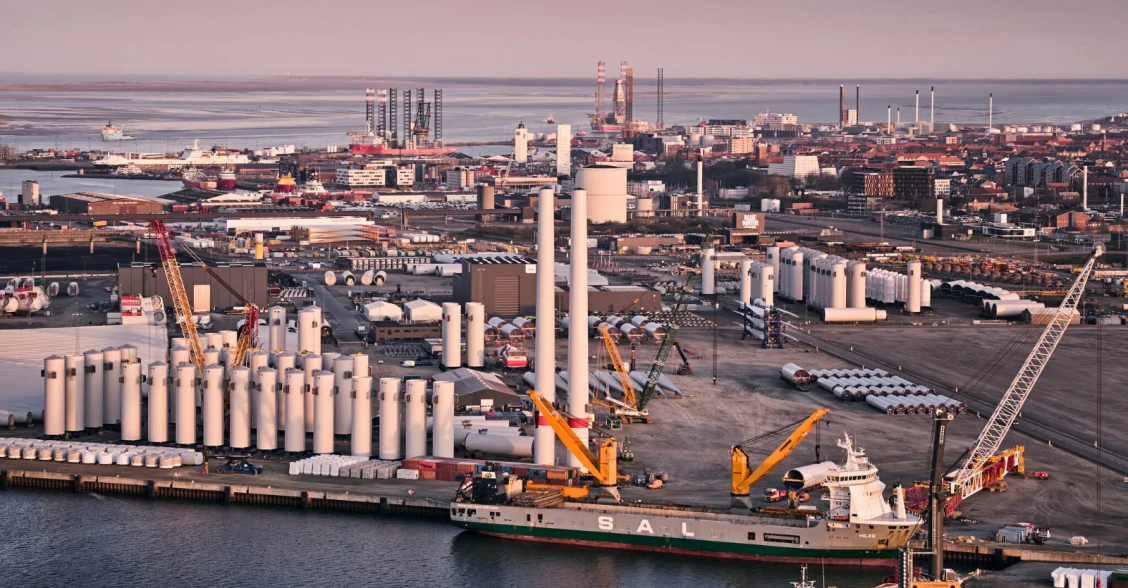
Port Esbjerg employs international partnerships and cross-border cooperation when looking for new ways to improve conditions for the businesses at the port. When international insights are turned into concrete practical solutions, innovation arises that makes a port resilient, green and ready for the future.
Ports are built for mobility. For goods, businesses and connections to the rest of the world. And when the world around us changes rapidly, ports are often the first to see how new patterns emerge and create new demands.
In this reality, innovation is not a choice, but a prerequisite for supporting green technologies, transport and security of supply.
This is no easy task. Port Esbjerg’s digital twin, the establishment of the new innovation hub and the deepening of the fairway are just a few examples of how the port has implemented innovative initiatives.
But above all, innovation requires a willingness to look beyond our own shores to gain the knowledge and insights that enable Port Esbjerg to evolve continuously.
A strong culture of innovation with international reach
In addition to being a European hub for RoRo transport and offshore wind, Port Esbjerg is known for its ability to create and ensure the best conditions for new technologies to emerge and develop across green technologies, digitalisation and logistics. With decades of experience in the field, Port Esbjerg knows that good ideas and new perspectives arise when innovative companies and individuals come together across national borders.
That is why Port Esbjerg has joined the global innovation network, Port Innovators Network (PIN). This global network creates a framework for the exchange of knowledge and experience and for constructive dialogue, enabling members to accelerate the development of green technologies and solutions in the maritime sector.
And it is safe to say that Port Esbjerg is in excellent company.
PIN is a global network that brings together eight ports from around the world that set the bar high for innovation. The network was founded by homePORT in Germany, THE PIER in Canada and Opentop in Spain. Since then, several other international ports have joined: Port of Açu in Brazil, Port of Bahía Blanca in Argentina and Port of San Diego in the USA – and most recently thinkport Vienna.
“It is crucial for the development of Port Esbjerg that we nurture a strong and active culture of innovation with international reach that can provide us with new knowledge and inspiration. This is precisely what we achieve through our collaboration in the Port Innovators Network,” says Dennis Jul Pedersen, CEO of Port Esbjerg.
Ports, research institutions and local businesses in and around the ports are all involved in PIN. Everyone is part of the conversation about how to find answers to the complex challenges that ports around the world share in terms of digitalisation, logistics and sustainable solutions. And we need solutions.
A fresh mindset
How do you create value for your customers while at the same time implementing a sustainable transition? This is the issue that Karen Sandrini, Eco System Relationship Manager at Port Esbjerg, encounters time and again in international debates on the role of ports in the green transition.
This issue was also the focus of the Green Inland Ports Final Conference in Vienna last month, where operators from across Europe gathered to discuss how inland ports can transition their operations in a more sustainable direction. The conference was hosted by PIN member thinkport Vienna.
Sandrini shared experiences from Port Esbjerg’s work with sustainability and innovation. In her opinion, there is no single solution.
“Whether we are talking about safety, bunkering, decarbonisation or new green technologies, it is all about asking the right questions,” she says, pointing to the need for a fundamental shift in the way ports develop solutions.
“How can a solution help companies address their challenges in practical terms? This is where value is created. And that requires us to share knowledge – both about what is difficult and what works. And not only internally at the ports, but very much so across national borders as well.”
Cooperation has become increasingly important as the role of inland ports in Europe has grown. Located inland and along rivers, they have proven their importance – not least during the Covid pandemic, when they were crucial in ensuring supplies to cities far from the coast. Today, they form a central part of the European transport network, TEN-T, connecting different modes of transport and supporting efficient freight transport.
“Our value cycle must be sustainable. All the way around,” Sandrini explains.
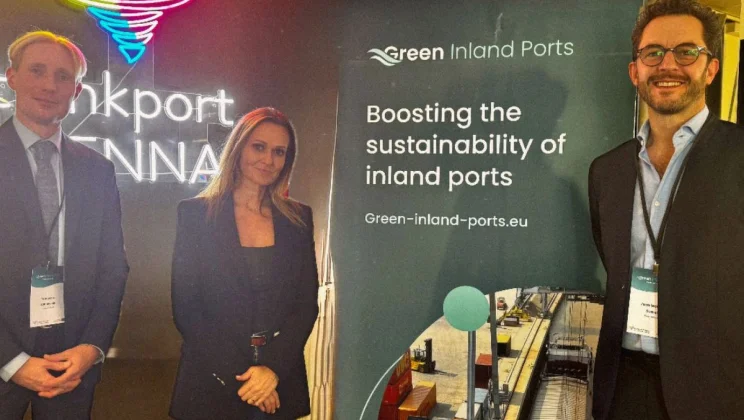
Esbjerg Harbour ECO System Relationship Manager Karen Sandrini together with Tommaso Spanevello from HAROPA Port and Juan-Manuel Suárez from PARIS TERMINAL SA at thinkport Vienna for Green Inland Ports.
Short path from idea to action
For Port Esbjerg, innovation is increasingly less about individual solutions and more about developing systems that work across operators, borders and value chains. In fact, this is the approach that has driven the port’s development over the past 150 years: the ability to test new solutions in practice and adjust them over time.
Jesper Bank, Port Esbjerg’s CCO, was reminded of this when he recently attended Maritime Innovation Week in London.
Port Esbjerg opened in 1874, and soon after, in the following year, the first route to England was established. What began as an association based on trade in bacon and dairy products has since developed into a central collaboration on RoRo transport and renewable energy solutions.
These days, more than 100,000 trailers are transported annually on the route. And the future potential of this route extends even further.
In conversations between Jesper Bank and the British Junior Minister for Aviation, Shipping and Decarbonisation, Keir Mather, the importance of strengthening the ties between Denmark and the United Kingdom was highlighted – particularly in the areas of offshore wind and hydrogen. The long-standing steady stream of goods and transport between Immingham/Hull and Esbjerg has created a natural basis for even closer cooperation across the North Sea.
Maritime Innovation Week also attracted strong representation from the Port Innovators Network. Thinkport Vienna, Port of Tyne and Opentop Hub from Valencia participated, alongside Port Esbjerg, in panel debates on international innovation and cooperation.
“You feel inspired when you meet visionary operators from ports around the world. It provides us with knowledge and experience that we can take home and put directly into practice,” Bank explains.
In his view, the ability to execute quickly has become a hallmark of Port Esbjerg.
“When we set a goal, we take action. This is possible because collaboration is fundamental to our success. This approach is widely recognised and inspires our partners in the network to achieve even better results,” he says.
Maritime Innovation Week left a clear impression: there is a willingness and the momentum to challenge the status quo. And cross-border cooperation is essential if we are to realise the potential.
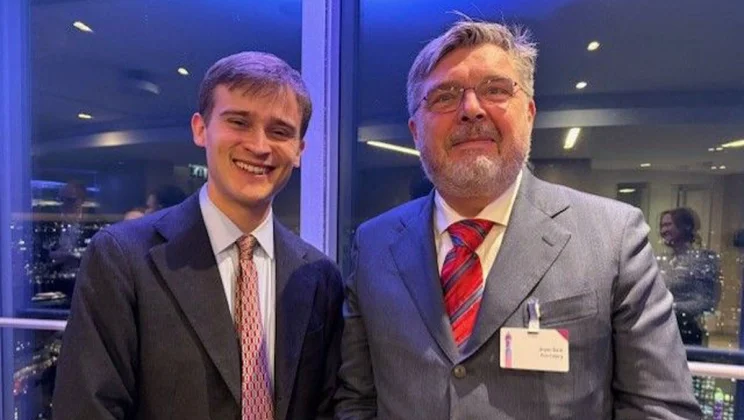
Esbjerg Harbour CCO Jesper together with British Junior Minister for Aviation, Shipping and Decarbonisation, Keir Mather, at Maritime Innovation Week.
No time to rest on our laurels
European ports are already showing the way forward to build the Europe of the future from the quayside. First and foremost, this process requires ports to have the right infrastructure and flexibility to meet the changing demands for solutions and services. However, a prerequisite for this is the innovation and knowledge sharing that takes place on a day-to-day basis at the ports.
This is only effective if ports constantly develop and innovate and are willing to invest in a future that they cannot fully know. This is also the case at Port Esbjerg, where the latest news is that we have come one step closer to CCUS storage in the North Sea with the installation of two tanks at the upcoming CO2 terminal in connection with INEOS’ Project Greensand. This is an impressive technological quantum leap and a project that is without precedent in the EU.
But that does not mean that Port Esbjerg is resting on its laurels. Quite the contrary in fact.
“The focus is on the next wave of innovation in the future of maritime operations and the necessary infrastructure. The market expects both ports and manufacturers to think continuously in terms of new and improved solutions that help optimise and rethink operations – so we have to deliver on that,” Sandrini concludes.
Go to overview