Got a question?

Administration
A new industry has taken off around carbon capture and storage (CCS), covering the transport, handling and storage of CO₂, and Port Esbjerg is playing a key role. A researcher from Aalborg University points to enormous potential.
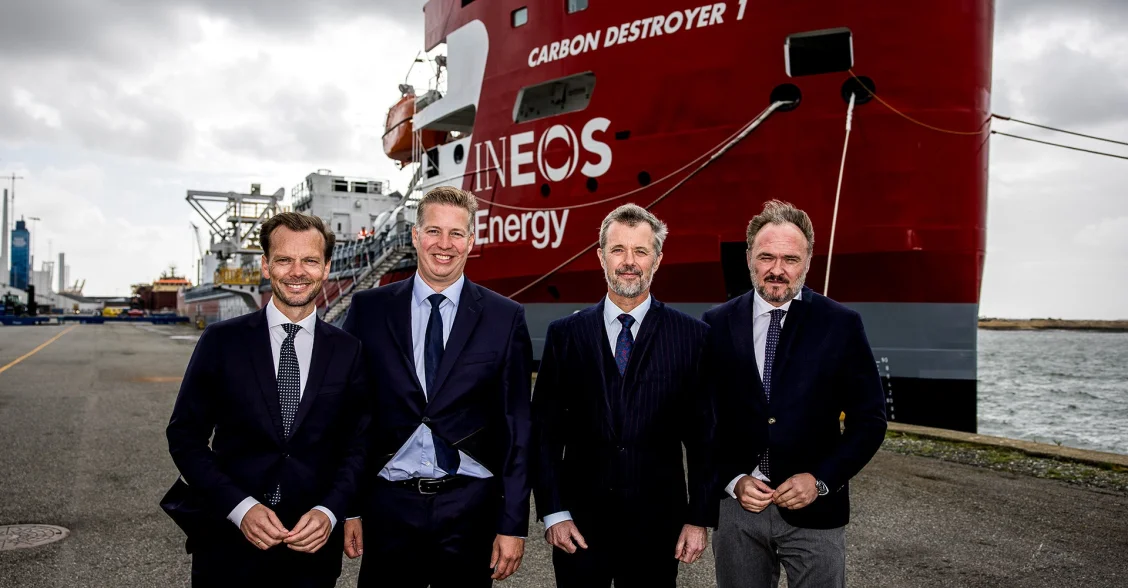
King Frederik and the founder of INEOS, Sir Jim Ratcliffe, helped launch Project Greensand at a grand ceremony at Port Esbjerg in September, as TV cameras rolled and a host of journalists scribbled away.
In the first project of its kind in the EU, INEOS – in partnership with Harbour Energy and Nordsøfonden, the Danish North Sea Fund – is putting the entire chain, from capture and transport to storage of CO₂, into commercial operation. And the potential for scaling up is considerable. Greensand expects to store up to 400,000 tonnes of CO₂ a year in the first commercial phase, with the possibility of scaling up to 4–8 million tonnes a year at full capacity.
The development has been welcomed by Dennis Jul Pedersen, CEO of Port Esbjerg.
"People have completely overlooked the opportunities that the oil and gas industry gives Denmark when it comes to carbon capture, because Danish geology is ideal for the purpose," he says, adding:
"In total, we can store up to 22 billion tonnes of CO₂ in the Danish sector of the North Sea. And by 2050, it will be possible to store 450 million tonnes a year once it is fully scaled up. In other words, Danish capacity is enough to cover storage needs for 48 years. People can hold many different views on the green transition, but CO₂ emissions have to be eliminated, and you won't solve that with wind turbines and solar panels alone."
From a single project to an entire industry
The project will receive CO₂ from sources including biogas plants, transport the gas to Port Esbjerg and then ship it out into the North Sea. There, the CO₂ is pumped approximately 1,800 metres down into a depleted oil field, where it is stored permanently.
Project Greensand is thus one of the projects that have helped move CCS from plans and aspirations to something that actually works in practice.
The technology is primarily intended for industrial companies whose emissions will not necessarily disappear, even if production becomes more energy-efficient or is powered by green electricity. The EU also estimates that carbon capture and storage must be expanded significantly if Europe is to meet its climate targets.
The question now is how the Danish-British experience can be used to build a far larger system focused on depleted oil and gas reservoirs in the North Sea.
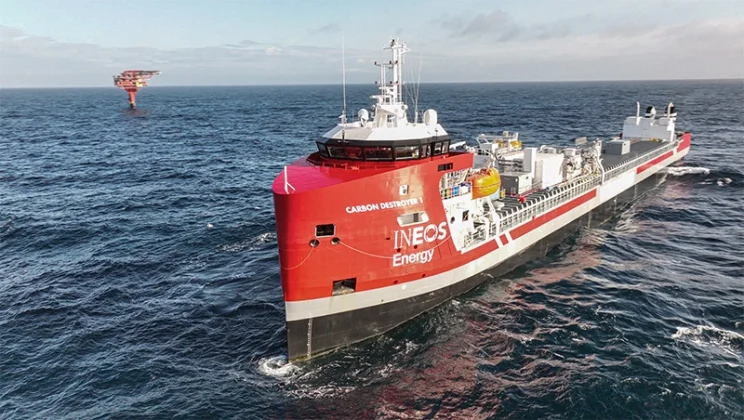
Photo: INEOS Energy
Port Esbjerg in the driving seat
For Port Esbjerg, then, this is not just about Project Greensand. It is about enabling a wide range of European companies to transport their CO₂ to Port Esbjerg, which can handle it.
Here, Port Esbjerg can facilitate onward transport out into the North Sea to the Danish storage sites, which can take large volumes. This is the infrastructure that now needs to be built up in earnest.
Project Greensand has, however, shown that the individual components can work together. But if CCS is to become a major part of Europe's transition, far more companies will need to get involved, and far larger volumes will be required. Both INEOS and the Danish state are now pushing for this.
Esbjerg is also located close to both the Danish companies that may need to send CO₂ for storage and the German industrial regions, where demand could be far greater. It is a development reminiscent of something Port Esbjerg has experienced before. Esbjerg was built on fishing; later came oil and gas, and then offshore wind became a central part of Port Esbjerg's business.
Now CO₂ is emerging as yet another area in which Port Esbjerg can play a role in the green transition, says Dennis Jul Pedersen.
"The green transition is about offshore wind and solar, yes, but not everything can make the switch. Heavy industry in Germany can't make that switch, and the hydrogen strategy isn't delivering on the targets that were set. That's where carbon management comes in," he says.
Germany – a key part of the market
For Port Esbjerg, it is not least the link to German industry that could prove significant.
Germany has a large heavy industry sector but limited options for storing CO₂ itself. Transport to the North Sea could therefore become part of the solution for companies that cannot eliminate all their emissions through electrification or other technologies.
This is where Esbjerg's location matters. At the same time, Dennis Jul Pedersen sees CCS as part of a wider European debate about industrial competitiveness.
"There is a clear link between the Draghi report, which points out that the green transition is cheaper if we can scale it up very quickly, and CCS, which can be scaled up quickly. According to our calculations, it delivers major cost savings, and a large share of Europe's industry still needs to make the transition," says Dennis Jul Pedersen.
European rules are driving development
Jakob Zinck Thellufsen holds a PhD and is an associate professor specialising in energy systems analysis at Aalborg University. He also believes that CCS will be an important part of the solution for emissions that cannot be eliminated through energy savings.
"There will be emissions that we can't avoid, for example from cement production. That's why we need to be able to capture and store CO₂," he states, adding:
"CCS is an important tool, but it is one tool among several. When you look at the energy system, we have a range of different solutions. We can put up wind turbines and solar panels, but as we look ahead to a climate-neutral society, there are still areas where emissions are difficult to avoid."
European regulation will also be important for companies' opportunities in the market.
"When it comes to competitiveness, the Carbon Border Adjustment Mechanism (CBAM) is an important part of the picture. If you want access to the European market, you have to comply with European requirements, and demand in Europe will drive a large part of the development. That's why it is important that EU countries stand together on requirements and framework conditions. It creates greater certainty for investment and can also help support the industries that Europe wants to retain," says Jakob Zinck Thellufsen.
North Sea geology works in its favour
The geological conditions in the North Sea make the area attractive for storage, Jakob Zinck Thellufsen emphasises. The potential is considerable. But it is also a question of how much CO₂ needs to be stored, and for how long.
"The North Sea can play a very important role for the whole of Europe when it comes to the transport and storage of CO₂. The potential of the North Sea storage sites is great, but it is also a question of how much CO₂ we need to store, and for how long?"
That said, CCS is not intended as a way of preserving all current emissions. Emissions must continue to be reduced, and the storage sites do, after all, have limited capacity, Jakob Zinck Thellufsen points out.
"It's important to stress that we also need to reduce our emissions. We can't simply capture all the CO₂, because at some point the storage sites will fill up. For most companies, it will be cheaper in the long run to electrify than to capture and store CO₂ in the North Sea. That is also an important part of the solution."
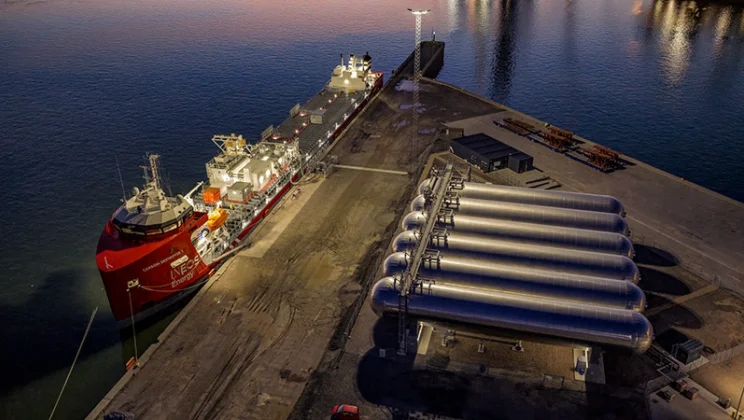
Photo: Robert Attermann, RED STAR 2.0
A market needs to be built
Another aspect of the development concerns negative emissions, where CO₂ is removed from the atmosphere or comes from biogenic sources and is subsequently stored permanently.
"If we look at negative emissions, in the longer term this could also involve direct air capture, where CO₂ is extracted from the atmosphere and stored. Or biogenic CO₂ from biogas, for example. If that CO₂ is stored permanently, you can achieve negative emissions, which can be used to offset other emissions, for instance from agriculture."
At the same time, there are technical challenges in building a larger European system for transport and storage, the researcher points out.
"The questions include how many facilities can operate at the same time, how we secure transport and how we design the right processes to handle CO₂ from different emitters. But fundamentally, from a technical point of view, we know how to do it."
The economic challenge is very much about securing sufficient volumes of CO₂ to use the storage sites efficiently.
"The economics of the storage sites are best if each individual storage location is used as fully as possible. That requires a sound business case at the point of capture, so that economies of scale can be achieved. The more CO₂ you can store, the cheaper it becomes."
Industry as a whole will play a central role in building up the market, Jakob Zinck Thellufsen concludes.
"It is very much our industry that will drive the development – together with biogas plants and waste incineration to begin with," says the researcher.
Go to overview