Got a question?

Administration
Fast, efficient and resilient ports and transport corridors are an essential element that will determine whether Europe regains its competitive edge, argues Boston Consulting Group. That requires stronger cross-border coordination, common standards and seamless connectivity – including efficient transitions between sea, rail, road and air. Port Esbjerg is one example of how this approach is being applied in practice.
How does Europe restore its competitiveness and reignite growth across the continent?
A new report by Boston Consulting Group (BCG) and the Confederation of Danish Industry (DI) offers a clear answer: after a generation of erosion, Europe can rebuild competitiveness by accelerating infrastructure investment and the execution.
At the centre of both the problem and the solution lies transport infrastructure. Ports, rail links, corridors and intermodal hubs are not just concrete and steel. They are economic choke points. When they work, Europe trades efficiently. When they fail, cargo is stuck in bottle necks and costs ripple through entire value chains.
“Infrastructure is a direct driver of competitiveness, productivity, energy and trade costs,” says Peter Jameson, Managing Director & Partner at BCG and co-author of the report “Ports and transport links are strategic choke points. If we do not fix them, Europe bleeds competitiveness.”
Boston Consulting Group’s report “Infrastructure for a Competitive Europe”
Infrastructure delivers strong economic returns
Logistics friction costs Europe an estimated €200 billion every year. Climate-related extremes added another 50 billion last year alone.
According to BCG, physical infrastructure for goods, people, energy and data sits at the heart of these challenges. Between 2025 and 2040, investments of around €12 trillion will be needed. In transport and maritime, an additional €1.0 trillion is required to modernise rail corridors, ports and roads. Underperforming ports, congested connections and fragmented cross-border corridors drive delays and costs across sectors.
“If a major port lacks smooth and seamless connection to inland distribution, cargo piles up, dwell times increase and shippers divert to cheaper foreign hubs. Local exporters lose competitiveness overnight,” Peter Jameson explains.
Port Esbjerg is one example of a port with strong multimodal connectivity. The port has direct links to motorways, rail and a nearby airport, enabling high-speed cargo flows.
The economic case for securing good connectivity for ports is strong. BCG estimates that every euro invested in infrastructure delivers between €1.2 and €2.1 in short-term economic return. Across Europe, that adds up to as much as €20 trillion in additional GDP over the next 15–20 years, or roughly €2,000 more output per citizen per year by 2040.
However, not all infrastructure investments deliver the same impact. Projects that cut system-wide operating costs generate the fastest and largest returns. In transport, for example, cross-border corridors and port-to-rail interchanges stand out.
For ports, priorities are practical: on-dock rail, intermodal terminals, digital traffic management to reduce queueing, shore power and green bunkering.
Port Esbjerg has recently completed fairway deepening, rail-terminal expansion and fully electrified RoRo operations, demonstrating how faster delivery and lower emissions can go hand in hand. hånd i hånd.
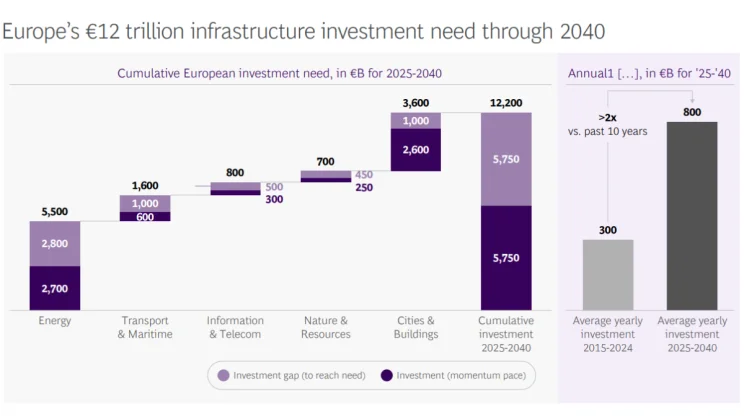
“Infrastructure for a Competitive Europe” highlights investment in Europe’s infrastructure through 2040.
Money is not the main problem. Execution is.
Europe’s infrastructure challenge is often framed as a funding issue. BCG’s analysis suggests that this view misses the complexity of the point.
Europe does need to invest around €12 trillion by 2040, roughly €800 billion per year, or 3.5 percent of GDP, more than double the historic spending levels. However, the main issue lies elsewhere.
“Most people agree on what needs to be built,” Peter Jameson says. “What’s missing is the ability to deliver, for example, permits, skills, supply chains and a delivery model that actually works.”
Today, only around 10 percent of infrastructure subsectors are on track to meet Europe’s targets. Roughly half of all projects are delayed and typically end up around 30 percent over budget. Cross-border projects perform even worse, with some TEN-T projects exceeding 50 percent cost overruns.
The issues are well known, yet hard to solve. Permitting often takes five to seven years. Rules differ across borders. Skills shortages and supply-chain constraints push costs higher.
A delayed port expansion or grid upgrade quickly triggers contractor repricing or supplier withdrawals. What starts as a viable project becomes fragile and unattractive to investors. As a consequence, Europe ends up paying more by moving slower.
Projects that succeed follow a different logic. They are industrialised and rely on clear accountability, standardised procurement, early contractor involvement and transparent risk-sharing. They use digital planning & delivery tools, not static Gantt charts.
“We seem to have lost our ability to ‘copy-paste’ well-proven projects. Today, almost everything is bespoke. Instead governments and the EU need to enforce repeatability and standardisation to accelerate,” he says.
From national patchwork to a European backbone
BCG argues for a simple but far-reaching shift: from fragmented national projects to a truly European infrastructure backbone.
In practice, this means prioritising the cross-border projects that create the most network value, financing them through standardised European vehicles and aligning technical standards and approvals so infrastructure works as one system – not 27 separate ones.
“Europe does not need another strategy paper. It needs a backbone that functions as a delivery machine, with financing, standards and accountability,” Peter Jameson says.
For transport and ports, this addresses Europe’s weakest link: cross-border coordination. Gaps in TEN-T connectivity, inefficient transitions between sea, rail and road, and incompatible national rules.
BCG estimates that institutional capital could contribute up to €1.4 trillion by 2040, yet much of it remains on the sidelines.
“Private capital will invest. But only when political and execution risk is visibly and contractually transparent,” he says.
Connectivity as a competitive advantage
Infrastructure today is not about individual assets, but about how well systems work together. At Port Esbjerg, connectivity is planned holistically, aligning port operations, on-site companies, road access, rail links and nearby air transport to enable fast, reliable and efficient cargo flows.
That approach extends beyond the port gate. Through close cooperation with other European ports, organisations and partners, Port Esbjerg helps ensure that infrastructure solutions connect across borders and that critical investments are prioritised in time.
“A modern port is defined by how well everything works together. When infrastructure and transport links connect locally and internationally, we can deliver the speed and reliability our customers expect,” says Dennis Jul Pedersen, CEO of Port Esbjerg.
As BCG underlines, ports sit at the intersection of trade, resilience and competitiveness. Europe’s challenge is no longer knowing what to build. It is proving that it can deliver – as one connected system.
Go to overview