Got a question?

Administration
From inspecting offshore wind turbines to piloting vessels: the integration of drones provides entirely new opportunities for developing and optimising operations at Port Esbjerg. Companies such as Vestas and DanPilot expect a great deal from the technology and are currently exploring its potential.
There is never a dull moment at Port Esbjerg. More than two hundred companies and ten thousand people are based at the port, covering an area of some five million square metres. This means that there is both space and a requirement for continuously exploring new opportunities to apply and to further develop existing technology in order to optimise port operations. The latest venture in this respect is the use of maritime drones.
It is not really about the drones themselves, but about the many new opportunities for optimisation that will be available to Port Esbjerg when the technology is integrated into the handling of existing tasks. The potential is already apparent – from piloting vessels to operating offshore wind farms far out in the North Sea.
“We are looking at ports around the world to see how the use of drones is being developed, tested and implemented to optimise operations. The ongoing dialogue we have with the businesses at our port – including through our Innovation Hub – gives us a deeper understanding of the general and individual needs of businesses. Our role is to develop the necessary infrastructure so that drones can help optimise activities,” says Dennis Jul Pedersen, CEO of Port Esbjerg.
Development based on the needs of businesses
Danish wind-turbine manufacturer Vestas and publicly owned DanPilot (Danish State Pilotage) are two of the companies leading the way in this area, and they recently participated in a workshop at Port Esbjerg’s Innovation Hub, where the use of drones is being explored.
For Vestas, the operation and maintenance of the wind turbines in the North Sea start from the quay at Port Esbjerg. The wind turbines are over twenty kilometres out to sea and they need to be serviced regularly throughout the year.
When Vestas undertakes scheduled maintenance at, for instance, Horns Rev 1 and 3, a service vessel sets off with technicians and the equipment they expect to need.
However, not everything can be planned in advance. While working, the technicians may find that they need additional tools or spare parts, which may mean delays or extra trips. This is where maritime drones come into their own, as equipment can quickly be flown directly to where it is needed before, during and after service tasks have been performed. Drones can therefore make wind-farm maintenance more flexible, reduce wasted time and ensure that work can start more quickly, even when the wind turbines are located far from the coast.
“We expect drones will have a great impact on streamlining the way offshore wind turbines are serviced. Cranes are currently used to load spare parts and tools onto vessels bound for the offshore wind turbines and again when the equipment is transported between the vessels and wind turbines. In some cases, crane operations account for up to a quarter of the total time required for a regular scheduled service inspection. Drones can deliver the equipment in advance of a scheduled service inspection, thereby reducing both time consumption and complexity. In the case of offshore wind farms with more than a hundred turbines, we are obviously expecting that to make a significant difference,” says Leon Raydon, Programme Director, Vestas.
For DanPilot, which is responsible for some of the pilotage services at Esbjerg and a number of other Danish ports, the use of drones in its operations has promising prospects.
Traditionally, the pilot sails out to the vessel when it arrives at the port’s fairway and boards it. The pilot advises the captain from the bridge, often with several tugboats in the water around the vessel.
Although the captain has an excellent view from the bridge and the pilots at the port know the fairway like the back of their hand, there are still blind spots and newly formed sandbanks and sand drifts on the seabed. This may mean that the vessel, weighing several thousand tonnes, has to correct its course.
Drones can help solve this issue, acting as “eyes” above the vessel.
“Drones can provide a bird’s-eye view that we currently do not have. They can quickly fly from starboard to port side and from stern to bow, sending live images and videos directly to the captains and pilots from angles they cannot see themselves,” says Brian Schmidt Nielsen, Project Manager at DanPilot.
A new software system and a new communication platform enable the drones to fly autonomously out to vessels approaching the port and direct them through the fairway at an earlier point. At the same time, the pilot can communicate with the captain of the incoming vessel without actually being on board.
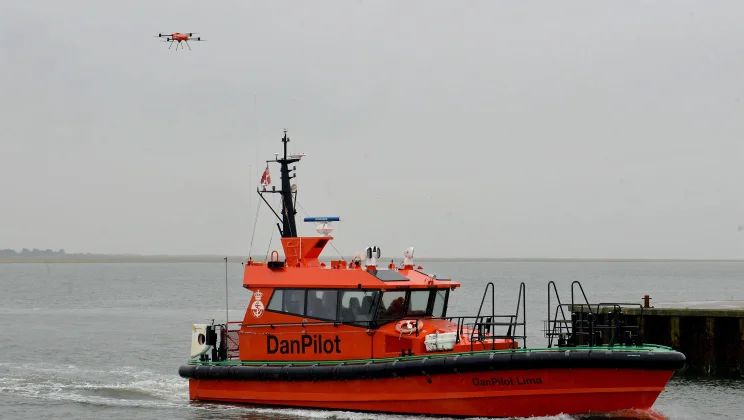
A DanPilot drone flies above a pilot boat and, in the longer term, will provide captains and pilots with a real-time bird’s-eye view during the approach, reducing blind spots and helping guide ships more safely and efficiently through the fairway.
The port is the perfect platform for development
With its high level of activity and the many maritime companies and industries gathered at Port Esbjerg, the port is the perfect environment for developing and testing the use of drones in operations. This becomes clear when companies collaborate at workshops and the Innovation Hub to work out how drones can support activities at the port.
Drones can optimise the logistics chain and contribute to more sustainable transport of small equipment. At the same time, they can take over risky tasks that currently require manpower – for example, moving packages between vessels via gangways which, in certain weather conditions, is either impossible or poses great risk to the crew.
“As a concept, drones have significant potential at Port Esbjerg, where the technology can help to improve the safety, sustainability and efficiency of maritime operations. In the long term, drones will play a greater role in how the businesses operate at the port,” Jul Pedersen concludes.
Drones and other intelligent technologies are also part of the European collaboration DIOL – Developing Innovative Offshore & Logistics solutions, of which Esbjerg Airport is the project manager. DIOL will support the Esbjerg Declaration’s goal of making the North Sea a hub for robust and transnational logistics chains for the maritime operations of the future.
Go to overview